Faster product launches
Get new ranges to market without weeks of manual updates


We’re here to replace clunky systems with dealer portals that actually work.
If your team dreads logging into the old portal, your dealers probably do too. Slow systems and endless workarounds waste time and frustrate everyone.
Dealer portal development means one clean platform where product data and marketing assets are always current. Less admin for your staff, a better experience for your partners, and more time spent selling instead of fixing problems.
We scope, design and build B2B portals that remove pain points and strengthen dealer relationships.
Our tried and tested four stage process gets you where you want to be:
Assess – Plan – Implement – Maintain
A modern partner portal is not just about reducing admin. It gives dealers the tools and information they need to sell more effectively.

Get new ranges to market without weeks of manual updates

Build trust by always providing accurate, current information

Make it easier for partners to promote and sell your products
We’ll choose systems, connect, design and build B2B portals that remove pain points and strengthens your dealer relationships. Our partner portals are planned and scoped include (but are not limited to…):
General marketing manager, Global manufacturing brandI had to jump in today due to sickness in the team and saw what a pain this old portal is. Can’t wait for the the new system!
As your dealer portal development partner, we make sure your portal works as a connected part of your business.
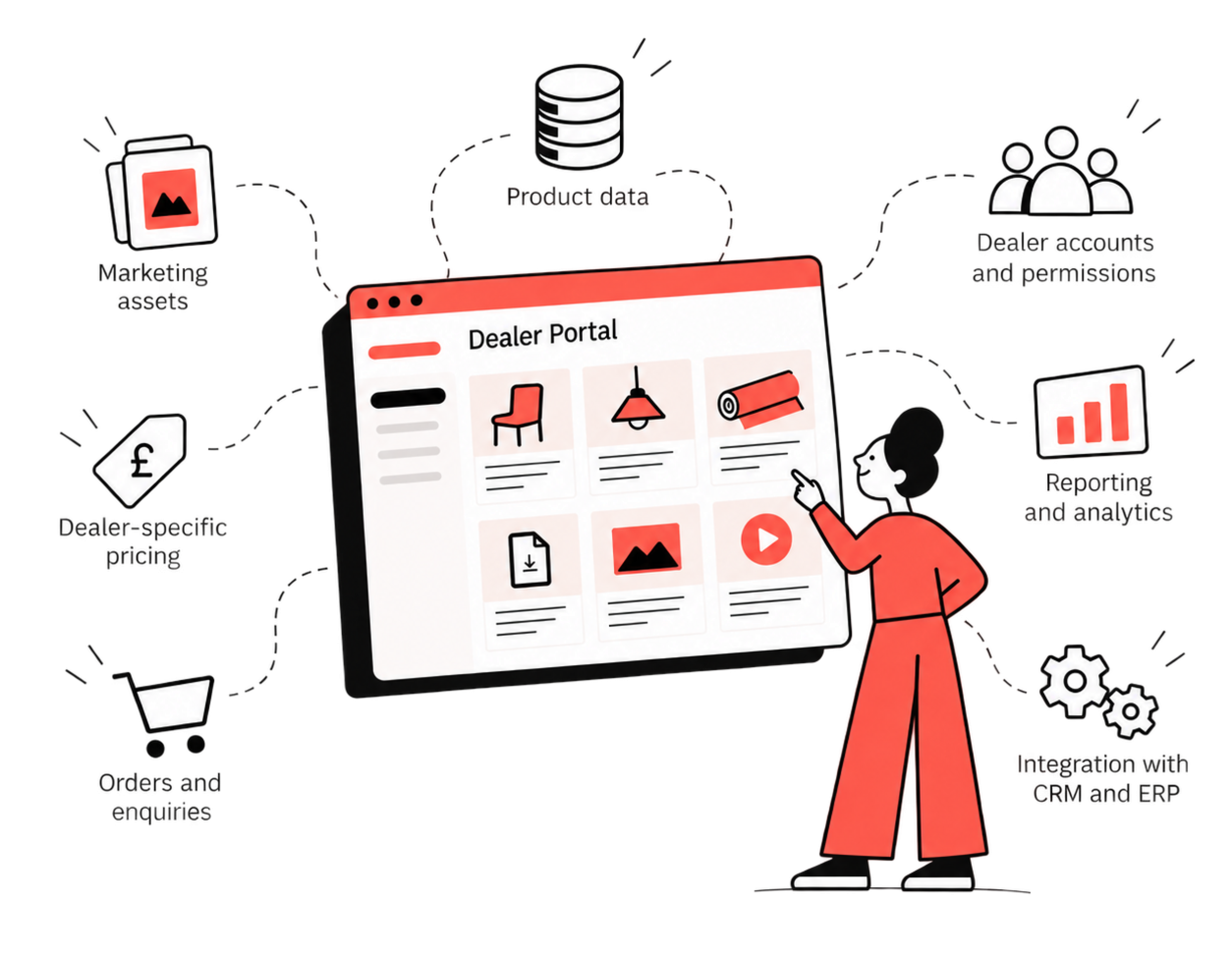
No more clunky logins or endless folders. We design B2B portals that link directly to your CRM and ERP so product data and assets stay consistent.
This reduces admin, removes duplication and gives your team and dealers a clear view of what’s current.
With our partner portal services you can be confident that sensitive pricing and dealer information stays secure.
We’re ISO 27001 certified, so your dealer portal will meet strict security standards.
We don’t just talk the talk – we build dealer portals that remove the pain of clunky systems.
The technology is rarely the issue. The real challenge is untangling processes that have grown messy over time, and mapping data that sits in different places. We work with you to understand how products, assets and pricing should move through the business, and then design the portal around that flow.
That way your team doesn’t waste hours keeping systems in sync, and your dealers always see accurate, up-to-date information.
All of our portals are built to be
We guide you step by step from mapping to launch, so the end result feels simple for your team and your partners.
A dealer portal only adds value if it keeps working day after day.
Integrations change, APIs update, and platforms break. If no one is watching, your dealers end up with missing data or outdated assets. That leads to frustration and lost sales.
We offer long-term support so your portal stays reliable. We monitor integrations, apply updates, and keep everything secure. Your team can focus on products and sales while we handle the technical shifts in the background.
With ongoing maintenance you get peace of mind and your partners get a portal they can trust.
From manual updates to real-time product data
We’re platform agnostic, but we often link dealer portals to core business systems so the data is always current. These include:
Whether your setup is cloud-based, legacy or custom, we’ll make the portal part of it so dealers get a single reliable source of information.
We work to ISO 27001 standards. That means access and permissions are designed in from the start. Sensitive commercial data like pricing, product launches and personal data stay protected. Portals aren’t just made to work – they’re secure and compliant as well as sustainable.
Building a partner portal isn’t just uploading files. The hard part is understanding how processes work today and deciding how product and asset data should flow between teams and dealers.
We map your data, design the structure, build and test the portal, and make sure it’s properly documented.
Training is part of the process too. Your team needs to know how to keep the portal current, not just how to log in. That way the system stays useful even when staff change or products evolve.